Medically reviewed by Dr. Muhammad Raza, Consultant Gastroenterologist & Hepatologist, Lahore.
“Doctor, I have acidity” is one of the most common things I hear — and sometimes it really is acid reflux. But surprisingly often, what patients call acidity turns out to be gallbladder trouble. Learning to recognise true gallbladder pain symptoms can save you months of the wrong treatment. Here is a practical, pain-location guide to telling the two apart.
Why the Confusion Happens
Both conditions cause upper abdominal discomfort, both can cause nausea and bloating, and both often appear after meals. It is no wonder patients — and even some general practitioners — mix them up. The problem: antacids and acid-reducing medicines do nothing for gallstones, so a misdiagnosed patient keeps suffering while the real problem goes untreated. A simple ultrasound can settle the question in minutes, which is why recognising the difference matters.
Gallbladder Pain Symptoms: The Classic Pattern
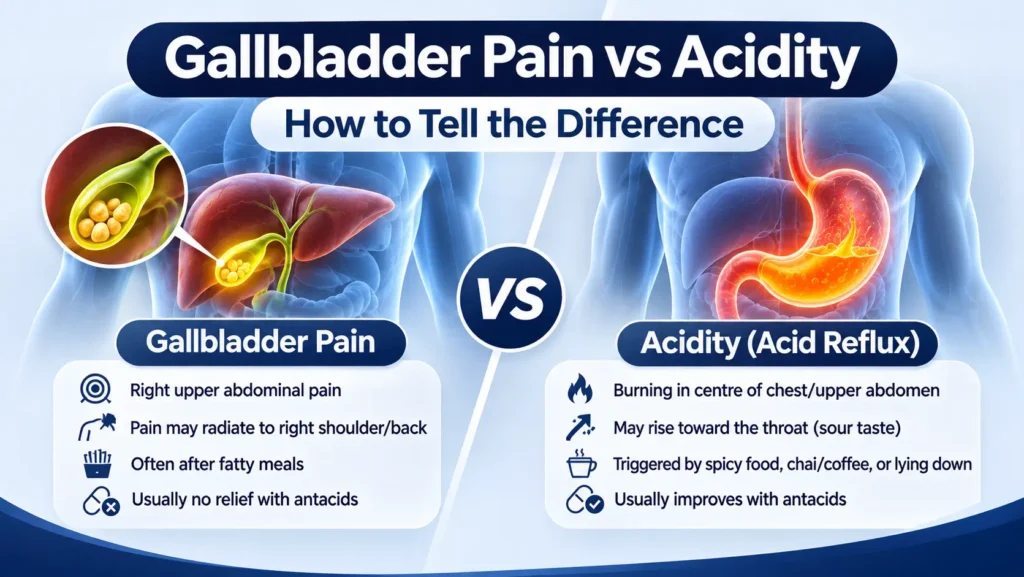
Gallbladder pain (biliary colic) has a distinctive fingerprint. Look for this combination:
- Location: Upper right abdomen, tucked just under the rib cage. This is the single most useful clue.
- Radiation: The pain often shoots through to the right shoulder or the back between the shoulder blades. Acidity does not do this.
- Timing: Begins 30 minutes to a few hours after a fatty meal — a fried breakfast, a heavy wedding dinner, Eid feasts.
- Nature: A steady, gripping, deep ache or pressure that builds over 15–30 minutes, plateaus, and lasts 30 minutes to several hours before fading.
- Companions: Nausea and sometimes vomiting; the pain does not improve with antacids.
If your “acidity” has this pattern — right-sided, shoulder-radiating, fat-triggered, antacid-resistant — think gallbladder, not acid.
Acidity (Acid Reflux): The Classic Pattern
True acidity or gastroesophageal reflux behaves quite differently:
- Location: Burning in the centre of the chest or upper middle abdomen — behind the breastbone, not under the right ribs.
- Radiation: May rise up toward the throat, causing a sour taste, sour burps, or a burning throat. It does not typically radiate to the shoulder.
- Timing: Often worse when lying down, bending over, or at night; frequently triggered by spicy food, chai or coffee, smoking, or late heavy dinners.
- Nature: A burning sensation rather than a deep gripping ache.
- Companions: Sour regurgitation, throat irritation, chronic cough, or a hoarse voice. Usually improves with antacids or acid-reducing medicines.

Side-by-Side Comparison
- Pain location: Gallbladder — upper right under ribs; Acidity — centre of chest/upper middle.
- Where it spreads: Gallbladder — right shoulder or back; Acidity — upward toward throat.
- Main trigger: Gallbladder — fatty/fried meals; Acidity — spicy food, caffeine, lying down after eating.
- Response to antacids: Gallbladder — little or no relief; Acidity — usually clear relief.
- Duration of episode: Gallbladder — 30 minutes to hours, then fully gone between attacks; Acidity — burning that comes and goes, often daily.
- Key test: Gallbladder — abdominal ultrasound; Acidity — often diagnosed by symptoms and response to treatment, with endoscopy if persistent.
When It Could Be Both (or Something Else)
Real life is messier than textbooks. Some patients have both gallstones and reflux. Others have neither — pain in the upper abdomen can also come from stomach ulcers, gastritis, pancreatitis, or even heart problems. Central chest burning that comes with exertion, sweating, or shortness of breath should always be checked for a cardiac cause first, especially in patients over 40 with diabetes or high blood pressure.
Also note: a single ultrasound showing gallstones does not automatically explain your pain. Many people have silent gallstones and their actual problem is reflux. Your doctor puts the symptoms and the scan together — never the scan alone.
What to Do Next: Getting a Clear Answer
If your symptoms match the gallbladder pattern — right-sided pain after fatty meals, especially with shoulder radiation — ask your doctor for an abdominal ultrasound. It is quick, painless, and widely available. Keep a simple symptom diary for a week or two: note what you ate, when the pain started, where exactly it was, how long it lasted, and whether antacids helped. This diary is enormously helpful at your appointment.
If your symptoms match the reflux pattern, a trial of lifestyle measures (smaller meals, no late-night eating, raising the head of the bed, cutting back on smoking and excessive chai) plus short-term acid-reducing medicines is reasonable. But if symptoms persist beyond two to three weeks, or you need daily medicines to function, get evaluated — persistent reflux deserves an endoscopy to check for inflammation, ulcers, or other causes.
Why the Right Diagnosis Saves You Time and Money
Mixing up these two conditions is expensive in every sense. Patients treated for “acidity” for months buy endless courses of antacids and acid-reducing medicines while gallstones quietly continue — sometimes progressing to gallbladder infection or a blocked bile duct, which turns a planned keyhole surgery into an emergency admission. Conversely, patients convinced they have gallstones sometimes push for surgery when a simple ultrasound shows a normal gallbladder and their real problem is reflux, which responds well to lifestyle changes and short-term treatment. A careful symptom history plus one well-timed ultrasound usually settles the matter in a single visit — far cheaper and safer than months of wrong treatment.
Red Flags: See a Doctor Promptly
- Severe upper abdominal pain lasting more than 5–6 hours
- Pain with fever and chills
- Yellowing of eyes or skin (jaundice)
- Vomiting blood or black, tarry stools
- Chest pain with sweating, breathlessness, or pain spreading to the jaw or left arm — treat as a possible heart emergency
- Unexplained weight loss or persistent vomiting
Frequently Asked Questions
Can gallbladder pain feel like heartburn?
Sometimes, yes — both cause upper abdominal discomfort after meals, which is why they are confused so often. The distinguishing features of gallbladder pain are its right-sided location under the ribs, radiation to the right shoulder or back, triggering by fatty meals, and poor response to antacids. When in doubt, an ultrasound gives a definitive answer about gallstones.
Why don’t antacids help my gallbladder pain?
Antacids neutralise stomach acid, which helps reflux and gastritis. Gallbladder pain comes from a stone blocking bile flow and the gallbladder contracting against it — acid has nothing to do with it, so antacids cannot touch the pain. If antacids consistently fail to help your “acidity,” that itself is a clue to look for another cause.
Can I have gallstones and acidity at the same time?
Yes, this is fairly common. Gallstones are often silent while reflux causes the actual symptoms — or both conditions can be active. This is why doctors correlate your symptom pattern with the ultrasound rather than treating the scan alone. A gastroenterologist can sort out which condition is driving your symptoms.
Should I get an ultrasound if I suspect gallbladder pain?
If your pain fits the gallbladder pattern described above — right upper abdomen, after fatty meals, possibly reaching the shoulder — then yes, an abdominal ultrasound is the right next step. It is non-invasive and inexpensive (approximately Rs. 2,000–4,000 in most Lahore labs, though confirm locally). Bring the report to a gastroenterologist for interpretation in the context of your symptoms.
Still unsure whether it’s your gallbladder or just acidity? Book an appointment with Dr. Muhammad Raza on WhatsApp — a proper evaluation and ultrasound review can give you a clear answer. Consultation fee is Rs. 2,000 (in-clinic and online).
This article is for information only and is not a substitute for professional medical advice. Please consult a qualified doctor for diagnosis and treatment.