
Medically reviewed by Dr. Muhammad Raza, Consultant Gastroenterologist & Hepatologist, Lahore.
Abdominal Pain Chart: What the Location Means
“Doctor, my stomach hurts” — but where exactly? The location of abdominal pain is one of the most powerful diagnostic clues in medicine. Different organs live in different parts of your belly, so mapping your pain narrows down the possible abdominal pain causes dramatically. This guide walks you through the abdomen quadrant by quadrant.
How to Read Your Abdomen: The Four Quadrants
Doctors mentally divide the belly into four quadrants — upper right, upper left, lower right, lower left — plus the central upper area (epigastrium, just below the breastbone) and the central lower area. Stand in front of a mirror and note exactly where your pain is strongest, whether it stays put or moves, and whether it spreads anywhere (to the back, shoulder, or groin). That information alone gets your doctor halfway to a diagnosis.
Upper Right Abdomen: Liver, Gallbladder, and More
Pain here — just under the right ribs — most commonly points to the gallbladder or liver:
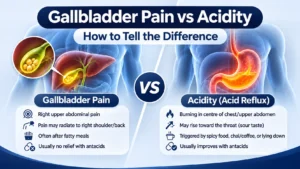
- Gallstones / gallbladder inflammation: gripping pain after fatty meals, often radiating to the right shoulder or back. See our detailed guide on gallbladder pain symptoms for the full pattern.
- Liver inflammation (hepatitis): dull ache or heaviness under the right ribs, sometimes with fatigue, nausea, or jaundice. Viral hepatitis is still common in Pakistan.
- Liver congestion or enlargement from heart or liver disease causes a heavy, dragging sensation.
- Less commonly: right kidney stones or infection, and pneumonia of the right lung base (yes — lung problems can masquerade as upper abdominal pain).
Upper Left Abdomen: Stomach, Spleen, Pancreas
- Gastritis and stomach ulcers: burning or gnawing pain just below the left ribs or centrally, often worse on an empty stomach (ulcer) or after eating (gastritis).
- Spleen problems: pain under the left ribs after infections like typhoid or malaria — both still seen in Pakistan — or after trauma.
- Pancreatitis: severe pain in the upper centre or left that bores straight through to the back, often with vomiting. A medical emergency — classically triggered by gallstones or heavy alcohol use.
- Left kidney stones or infection can also present here.
Central Upper Abdomen (Epigastrium): The Crossroads
Pain right in the centre, just below the breastbone, is the classic zone for acid reflux, gastritis, and stomach or duodenal ulcers. It is also where gallbladder pain sometimes starts before localising to the right, and where pancreatitis pain centres. Because so many conditions share this spot, the character of pain matters most here: burning suggests acid; deep boring pain radiating to the back suggests pancreas; colicky waves after fatty food suggest gallbladder.
Important: pain in this central area can also be the heart — especially in people over 40 with diabetes, high blood pressure, or smoking history. Heart-related pain may come with sweating, breathlessness, or radiation to the jaw or left arm. When in doubt, rule out the heart first.
Lower Right Abdomen: Appendix Territory
- Appendicitis: the classic story — pain starts vaguely around the navel, then shifts to the lower right and becomes sharp, worse with movement, coughing, or pressing and releasing. Usually with loss of appetite, nausea, and low-grade fever. This needs urgent surgical evaluation.
- Ovarian or testicular issues: ovarian cysts or torsion in women; in men, testicular pain can occasionally be felt here.
- Kidney stones: waves of severe pain radiating from the back or side down toward the groin, often with burning urination or blood in urine.
- Crohn’s disease often affects the junction of small and large intestine in this region.
Lower Left Abdomen: Colon and Diverticular Disease
- Diverticulitis: inflammation of small pouches in the colon wall — steady pain in the lower left with fever, increasingly recognised in Pakistan as diets change.
- Constipation and IBS: crampy, shifting pains that ease after passing stool or gas — very common and usually benign.
- Ovarian cysts, endometriosis, or pelvic infection in women.
- Kidney stones on the left side.
Central Lower Abdomen and Around the Navel
- Early appendicitis often starts as vague pain around the navel before moving right.
- Intestinal cramps from gastroenteritis, food poisoning, or IBS centre here.
- Bladder infection: pain just above the pubic bone with burning urination and frequency — common in women.
- In men, prostate issues can cause deep central lower discomfort.
Diffuse or Whole-Abdomen Pain
Pain all over the belly suggests conditions affecting the entire gut: gastroenteritis (with vomiting/diarrhea), widespread IBS cramping, food poisoning, or — in severe cases with a rigid, board-like abdomen — a surgical emergency like a perforated ulcer. Severe, diffuse pain with a hard belly and fever needs immediate hospital care.
How Doctors Use This Map (and Its Limits)
Location narrows the field, but your doctor combines it with the pain’s character (burning, cramping, sharp, dull), timing (after meals, at night, constant), associated symptoms (fever, vomiting, jaundice, bleeding, urinary symptoms), and examination findings. Tests then confirm: ultrasound for gallbladder and kidneys, endoscopy for stomach and duodenum, colonoscopy for the colon. No chart replaces this clinical judgment — use this guide to describe your pain accurately, not to self-diagnose.
Red Flags: Seek Urgent Care
- Sudden, severe pain — “the worst pain of my life”
- Pain with a rigid, board-like abdomen
- Vomiting blood or black stools
- High fever with abdominal pain
- Signs of shock: cold sweats, rapid pulse, faintness, confusion
- Severe pain in pregnancy
- Chest-type pain with sweating or breathlessness (possible heart attack)
Frequently Asked Questions
Can gas cause pain in a specific location?
Yes — trapped gas can cause surprisingly sharp, localised pain, most often in the upper abdomen or under either rib cage (the bends of the colon sit there). Gas pain typically shifts around, eases after passing gas or a bowel movement, and isn’t accompanied by fever or vomiting. If the pain is fixed in one spot and persistent, get it evaluated rather than assuming gas.
What does pain under the right ribs usually mean?
Most commonly gallbladder or liver-related causes: gallstones, gallbladder inflammation, or hepatitis. The classic gallbladder pattern is pain 30 minutes to hours after fatty meals, sometimes reaching the right shoulder. An abdominal ultrasound is the usual first test for right upper abdominal pain.
When is stomach pain an emergency?
Treat it as an emergency with sudden severe pain, a hard rigid belly, vomiting blood, black stools, high fever with pain, faintness or cold sweats, or severe pain during pregnancy. Also, central chest or upper abdominal pain with sweating and breathlessness in at-risk adults should be assessed for a cardiac cause without delay.
Should I get tests based on pain location alone?
Location guides which tests are sensible, but tests should follow a doctor’s assessment, not self-ordering. For example, right upper pain usually warrants an ultrasound; persistent central burning may need endoscopy; lower abdominal changes in bowel habit may need colonoscopy. A consultation ensures you get the right test, not just more tests.
Unsure what your abdominal pain means? Book an appointment with Dr. Muhammad Raza on WhatsApp — describe your pain location and get a proper diagnosis in Lahore. Consultation fee is Rs. 2,000 (in-clinic and online).
This article is for information only and is not a substitute for professional medical advice. Please consult a qualified doctor for diagnosis and treatment.