Medically reviewed by Dr. Muhammad Raza, Consultant Gastroenterologist & Hepatologist, Lahore.
Stomach cramps before an important meeting, urgent trips to the washroom, bloating that makes you loosen your belt by afternoon — if this sounds familiar, you may be one of the many people living with irritable bowel syndrome (IBS). It is uncomfortable and often embarrassing, but it is also manageable. This guide explains IBS in plain language, with practical advice for Pakistani patients seeking effective IBS treatment in Pakistan.
What Is IBS?
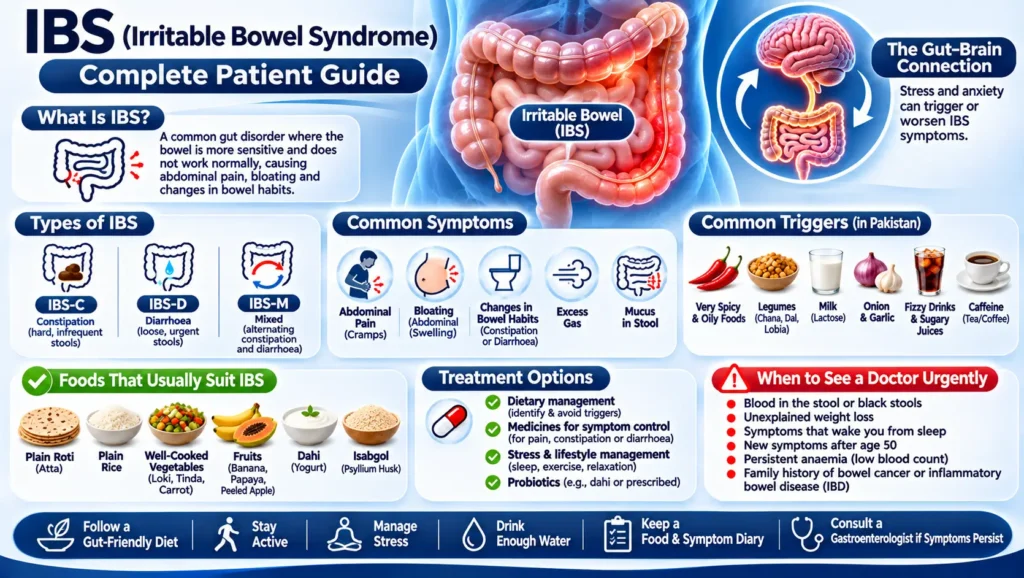
IBS is a functional disorder of the gut — meaning the bowel looks normal on tests, but it does not work normally. The intestines become overly sensitive and their muscle contractions become irregular, causing pain, bloating, and changes in bowel habits. Importantly, IBS does not damage the intestines and does not lead to cancer, though it can significantly affect quality of life.
IBS commonly begins in young adulthood and is seen more often in women, though men get it too. Many patients suffer silently for years, assuming it is “just gas” or a weak stomach, before learning there is a name for their condition — and a treatment plan.
Types and Symptoms of IBS
IBS is diagnosed based on a pattern of symptoms, typically abdominal pain at least one day a week over several months, associated with changes in stool frequency or appearance. There are three main types:
- IBS with constipation (IBS-C): hard, infrequent stools, straining, feeling of incomplete emptying.
- IBS with diarrhoea (IBS-D): loose, urgent stools, sometimes soon after eating.
- Mixed IBS (IBS-M): alternating between constipation and diarrhoea.
Across all types, bloating and visible abdominal swelling are among the most distressing symptoms — many patients say they look several months pregnant by evening. Excessive gas, mucus in the stool, and pain that eases after passing stool are also typical. Symptoms often follow a pattern: worse during stress, after certain foods, or during hormonal changes.
What Causes IBS? The Gut-Brain Connection
The exact cause of IBS is not fully understood, but research points to a combination of factors: an overly sensitive gut nervous system, altered gut bacteria, low-grade inflammation, and — very importantly — the gut-brain connection. The gut and brain constantly communicate, which is why anxiety, exams, work stress, or emotional upset can trigger a flare within hours.
This is not “all in your head” — the symptoms are very real. But it does mean that managing stress is a genuine part of treatment, not an afterthought. In Pakistan, where discussing stress or anxiety still carries stigma, many patients are surprised (and relieved) to learn that their digestive symptoms and their stress levels are medically linked.
Sometimes IBS begins after a bout of food poisoning or stomach infection — so-called post-infectious IBS. Given how common contaminated food and water are here, this is a pattern I see regularly.
IBS and the Pakistani Diet: What Helps, What Hurts
Diet is the single biggest lever most patients can pull. But generic Western IBS diet charts do not always translate to our kitchens, so here is practical guidance with Pakistani foods:
Foods that commonly trigger IBS flares
- Very spicy and oily foods: heavy karahi, nihari, paye, and deep-fried snacks.
- Legumes in large quantities: chana, lobia, and dal can cause gas — though small, well-cooked portions are often tolerated.
- Milk: many adults with IBS are also lactose-sensitive. Dahi (yogurt) is usually better tolerated than doodh.
- Raw onions, garlic, and cabbage family: common gas producers.
- Fizzy drinks and very sweet juices: excess fructose can worsen diarrhoea-type IBS.
- Caffeine: stimulates the bowel — a trigger especially for IBS-D.
Foods that usually suit IBS
- Plain white rice, khichdi, and soft roti in moderate portions
- Well-cooked vegetables like loki (bottle gourd), tinda, and carrots
- Bananas, papaya, and peeled apples
- Dahi and lassi (probiotic-friendly)
- Isabgol (psyllium husk) — a traditional, effective fibre for both constipation and diarrhoea types when used correctly
Keep a food and symptom diary for two to three weeks. Patterns usually emerge quickly, and they are far more useful than blindly eliminating entire food groups, which can lead to nutritional deficiencies.
IBS Treatment in Pakistan: What to Expect
There is no single cure for IBS, but a combination approach controls symptoms well for most patients. IBS treatment in Pakistan typically includes:
1. Dietary management
Based on your diary and type of IBS, your doctor may suggest a structured eating plan — sometimes a low-FODMAP approach adapted to Pakistani foods, sometimes simpler targeted eliminations. The goal is the least restrictive diet that keeps you comfortable.
2. Medicines for symptom control
Depending on your symptoms, doctors may prescribe antispasmodic medicines for cramps, fibre supplements or gentle laxatives for constipation-type IBS, anti-diarrhoeal medicines for urgent loose motions, or gut-directed medicines that regulate bowel function. Low doses of certain medicines that calm gut-brain signalling are sometimes used for pain-predominant IBS. All of these should be started on medical advice, not self-prescribed.
3. Stress and lifestyle management
Regular sleep, daily walking, and stress-reduction techniques genuinely reduce flares. Some patients benefit from gut-directed hypnotherapy or counselling — these are medical treatments for a medical condition, not a suggestion that symptoms are imaginary.
4. Probiotics
Certain probiotic strains may help bloating and irregularity in some patients. Dahi is a natural, affordable source. Commercial probiotics vary in quality, so discuss the choice with your doctor.
When IBS Symptoms Need Urgent Attention
IBS itself does not cause bleeding, weight loss, or anaemia. If you notice any of the following, see a doctor promptly — they suggest something other than (or in addition to) IBS:
- Blood in the stool or black stools
- Unexplained weight loss
- Symptoms that wake you from sleep
- Family history of bowel cancer, coeliac disease, or inflammatory bowel disease
- New symptoms after age 50
- Anaemia or persistent fatigue
In such cases, your doctor may recommend a colonoscopy to examine the large intestine directly. It is also worth noting that conditions like coeliac disease and inflammatory bowel disease can mimic IBS, so a proper evaluation matters before settling on the diagnosis.
Frequently Asked Questions
Is IBS curable?
IBS is a chronic condition without a one-time cure, but it is highly manageable. Most patients achieve good control with diet adjustments, stress management, and targeted medicines during flares. Many find their symptoms improve significantly over time, with long quiet periods between episodes.
Can stress alone cause IBS?
Stress rarely causes IBS on its own, but it is one of the strongest triggers for flares because of the gut-brain connection. Managing stress — through regular sleep, exercise, and relaxation — is a legitimate and effective part of treatment. It does not mean your symptoms are not real.
Should I avoid roti and rice if I have IBS?
Usually not. Plain roti and white rice are well tolerated by most IBS patients and are important energy sources. Problems more often come from what accompanies them — very spicy salan, large amounts of dal or chana, or fried sides. Adjust the accompaniments before blaming the staples.
When should I see a gastroenterologist for IBS?
See a specialist if symptoms persist beyond a few weeks despite diet changes, if they interfere with work or social life, or if you notice any red-flag symptoms like bleeding or weight loss. A consultation (approximately Rs. 2,000 at our clinic — please confirm when booking) can clarify the diagnosis and set up a proper plan. Our FAQs page answers common questions about visits.
You Can Take Control of IBS
IBS can feel unpredictable and isolating, but it responds well to a structured approach: understanding your triggers, eating in a way that suits your gut, managing stress, and using medicines wisely during flares. You do not have to plan your life around the nearest washroom. With the right IBS treatment in Pakistan, most patients get back to eating, working, and socialising with confidence.
Book an appointment with Dr. Muhammad Raza on WhatsApp to get a personalised IBS evaluation and diet plan. You can also read about Dr. Raza’s background or contact the clinic for more information.
This article is for information only and is not a substitute for professional medical advice. Please consult a qualified doctor for diagnosis and treatment.